
DISCLAIMER:
If you have access to this page, it is because you have been onboarded as a Biz Dev for Obsidian Solutions. Do not share this page. This is your confidential help/training center.
Contents:
- Intro & the Basics (3 min)
- Contact (1 min)
- Key Links (1-10 min)
- $$$ (2 min)
- Onboarding Video (10 min)
- Partner Types (10 min)
- PDFs (5 min)
- Job Description (3 min)
INTRO & THE BASICS
Firstly, WELCOME! We are so excited to have you as a part of our team and are excited to work together towards the goal of making fair money and getting peoples their homes back, whether they were affected by a dishwasher leak accross the kitchen or a catastrophe like hurricanes and fires.
If you are here, it is because you can sell black paint to the white house and/or have copious experience and contacts in the property claims industry.
Tight Role Definition:
Sales just close deals… You are a Business Development Officer.
Biz Devs find, build, and grow relationships that lead to new business.
Core Mission
Your role has three stages:
1. Prospect
Identify potential referral partners.
Examples:
- plumbers
- roofers
- mitigation companies
- HVAC
- insurance brokers
- tree guys
Use any ethical method:
- door knocking
- cold calling
- networking
- digital outreach
- industry events
- referrals
2. Close
Get Clients to sign (or you can fill it out for them) our New Partner Form (in Key Links section below) and get them to start sending projects.
You must:
- understand the pitch
- handle objections
- educate partners
- make the process easy
3. Maintain
Get them to continue sending projects. After a partner sends projects, you must:
- check in regularly
- answer questions
- reinforce the process
- make sure projects keep flowing
This is why the role functions part sales + part relationship management.
The One Metric That Matters
Everything reduces to:
Producing partners.
A producing partner = a partner who sends at least 4 projects per month that are at least $5K gross revenue (industry average property claim is $16K with recon being $12K.
CONTACT
We aim for our Biz Devs to prospect, close, and maintain clients directly, but situations occur where backup, clarifications, or other help is needed.
Jake Ryan – CEO of Obsidian Solutions
+1 (541) 780-0640
Can Text from 9:30 AM – 3:30 PM PST for Biz Dev inquiries only
JakeRyan@ObsidianSolutions.com
Can share
Booking Link reserved for helping close clients: https://calendly.com/meetjakeryan/30min
Ideal Option: book the meeting for the client (with you sitting in on meeting). Input the info template below into the “Please share anything that will help prepare for our meeting” section.
Option 2: If a client wants to book a meeting or call, please inform Jake via text using the info template below:
Lead Company Name:
Location (City, State):
Lead Contact Name:
Lead Contact Number:
Lead Contact Email (usually only needed if their preferred method of communication):
Context and Details (as much as possible):
KEY LINKS
New Partner Form:
https://form.jotform.com/242456802826157
1-min Form to Send Us Projects:
https://form.jotform.com/252536550724053
Partner Pitch Video:
https://form.jotform.com/242456802826157
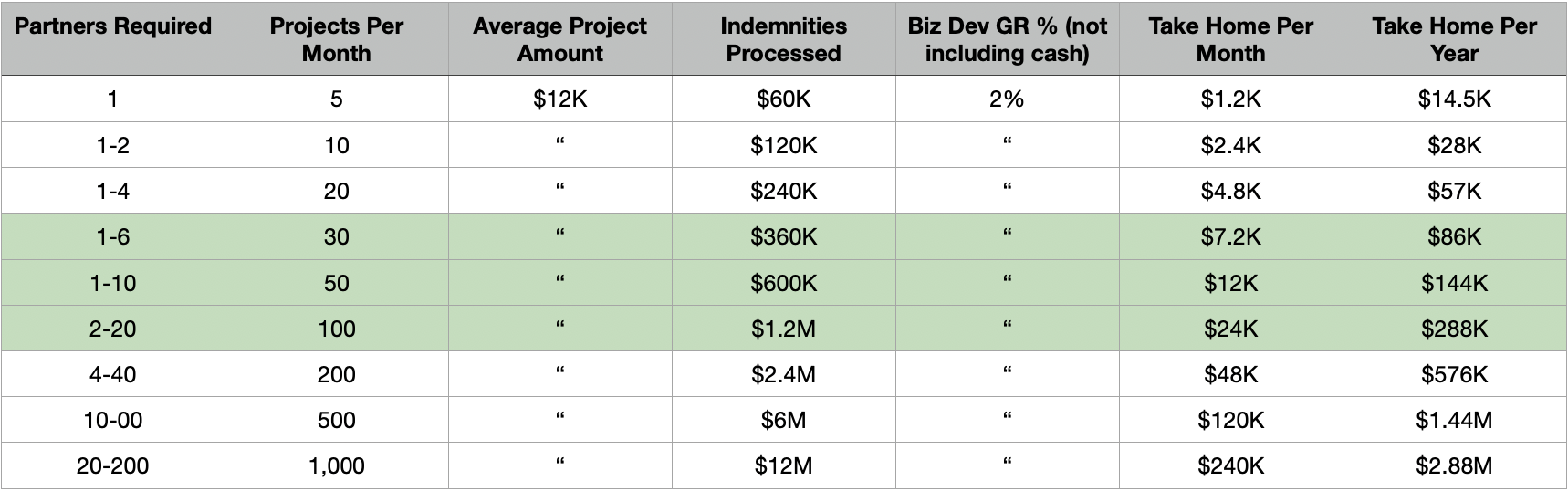
$$$
Partner Types range and so does what they can produce for Obsidian.
Industry Example 1:
Mitigation Companies who do not do repairs average 18 – 60 projects that need reconstruction per month. Of course some do less, some do more
Industry Example 2:
Agencies/Brokers have 800 – 2,500 property policyholder clients @ 4 – 7% filing a claim annually = 32 -175 claims / 12 = 2.6 – 15 projects per month
Green is the obtainable aim goal.
ONBOARDING VIDEO
Video Revisions:
- Video states 1%, but our Biz Dev program you have signed up for is 2% of Gross Revenue. The 1% is for our PPP (Partners Partner Program), Partners who get us other Partners
- Obsidian will go up to 5% Gross Revenue kickback upon project completion, but no more than that, but ideally none if we can swing it. If you obtain producing partners with 0 kickback, you will get a $2,000 bonus!
PARTNER TYPES
1) MIT COMPANIES THAT DO NOT DO REPAIRS
Summary / Dynamics with Us
These are one of the most proven partner types we have because they are already on the loss early, understand insurance work, and naturally hand off at the repair phase. They are further down the claim-origin chain than plumbers/adjusters/brokers, but they are still extremely valuable because the handoff into reconstruction is direct and logical. They are often distrustful, protective of their reputation, and money-hungry, which makes them sometimes difficult to land.
Pros
- Close to live claims
- Understand claim flow better than most partner types
- Natural handoff at repair phase
- Often recurring volume
- Easier to explain your value to than plumbers/tree/HVAC
- If landed, can become very long-term and high-value
Cons
- Distrusting
- Often already have a repair relationship
- Often want aggressive kickbacks
- Many do repairs internally
- Some want you only as a sub, not as true handoff partner
- If they are sloppy, you inherit messy clients/files
Ease of Obtaining
Medium
Can be harder than plumbers. Easier than brokers/adjusters/carriers.
Best targets:
- Mit only
- Mit radius > repair radius
- Too busy for recon
- Burned by prior repair vendors
- Want monetization without carrying recon burden
Most Common Objections and Retorts
Objection: “Wait so what is it you guys do?” / “What kind of work do you do?”
Retort:
We partner with mitigation companies by taking the repairs from start to finish. That means we handle the insurance back-and-forth until repair price consensus, all preconstruction, scheduling, and the physical construction process through final completion. If it’s insurance or construction, that’s our lane.
Objection: They only offer email and won’t transfer you
Retort:
I’ll absolutely send that over, but I’ve noticed these usually go nowhere unless I can actually reach the right person. Any chance you’d be willing to pass me a direct line or transfer me to voicemail if they’re busy?
Objection: “We have a repairs department.”
Retort:
Totally fair. Quite a few of our partners do too. Usually where we help is if your mit radius is larger than your repair radius, if you get too busy, or if certain jobs are too large or too complex and need a clean handoff.
Objection: “Not interested.”
Retort:
I’d be doing you a disservice if I didn’t at least try to show you the upside, which is simple: we make everyone money and help get people back in their homes. Can I ask what makes it a no right now?
Objection: Kickbacks
Retorts:
- Only paid upon project completion and final funds received by client and/or insurance.
- We can structure on net or gross depending on what makes sense, but we are disciplined because we still have to actually execute the project.
- If it gets too high, it starts eating the margin required to run the job properly. A lot of contractors say yes to higher percentages because they’re desperate, then they underperform, don’t pay, or burn the client.
- We are trying to build a long-term partnership, not buy one job and disappear.
- We have never lost a mit partner, and that is not for no reason.
Objection: “We usually only use other contractors as a sub.”
Retort:
Our partners usually kick the job to us entirely as the GC. We are a full start-to-finish service for the client and take the whole recon burden off your plate with less liability and less coordination for you.
Objection: “What areas do you cover?”
Retort:
Everywhere you have work.
Objection: “Do you have crews or what?”
Retort:
We have travel crews, and when we are at capacity we use a vetted and approved subcontractor network so jobs don’t get delayed. Our talent pool is high because we get subs who otherwise would never touch insurance work because we handle that.
Objection: “Do you handle small repairs?”
Retort:
Ideally nothing below $4K, but if it helps build a real relationship, we’re open to proving ourselves on smaller ones. Our model just works best on larger claims. Bigger the better.
Objection: “Why trust you?”
Retort:
Because what we’re doing isn’t new for us. We already run this in live markets with referrals willing to vouch for us, and our whole model depends on protecting your reputation. If we fail your client, we lose the relationship.
2) PLUMBERS
Summary / Dynamics with Us
Plumbers are one of the best origin-point partners because they often get called first on leaks, bursts, and overflows. They are closer to the source of claim origination than mit companies. They often discover the problem is more than just plumbing and currently send that work to mitigation or restoration companies. You want to intercept that handoff. They can be easier to obtain than mit companies, but increasingly harder because other companies are throwing huge kickbacks at them.
Pros
- Very close to claim origination on water losses
- Huge market
- Easier to source and pitch than mit/brokers/adjusters
- Frequent opportunities
- Simple economics resonate with them
- Great if you stay top-of-mind
Cons
- Less sophisticated on claim flow
- Often already sending to a mit company
- Becoming more expensive to win because of aggressive upfront referral fee competition
- Harder to stay top-of-mind unless your handoff is extremely simple
- Often have multiple plumbers on team who all do referrals their way
Ease of Obtaining
Medium
One of the easier high-value partner types to recruit.
Best targets:
- Service plumbers
- Emergency plumbers
- Leak response plumbers
- Plumbers who see insured water damage regularly
Most Common Objections and Retorts
“Do y’all currently pass jobs off that need more work like water damage to mit companies?”
This is your opener, not their objection, but it’s good because it forces the frame.
Objection: “No, we don’t.”
Retort:
Is that something you might be willing to consider doing?
If still no:
Is it because you don’t really do service work so you don’t come across it, or is it more that you’re protective of your reputation referring folks out?
Objection: “What are you?”
Retort:
We do end to end property claim project management as a full service restoration company, so when you find a plumbing job that becomes a bigger insurance loss, we can take it from there start to finish.
Objection: “Wait so what is it you guys do?”
Retort:
We do insurance restoration and construction from start to finish. So when plumbers get jobs that need more work, they pass them to us and we take care of the rest — insurance back-and-forth, mitigation, contents, rebuild, everything.
Objection: They only want email / won’t transfer you
Retort:
I’ll send it over, but these usually die unless I can actually reach the right person. Any chance you’d be willing to transfer me, pass a direct line, or send me to voicemail?
Objection: “We already are at capacity with who we send stuff to.”
Retort:
Totally fair. From 1 to 100, with 100 being absolute no and 1 being yes, where are you leaning on giving us a shot to earn a place in the rotation?
Objection: “Not interested.”
Retort:
I’d be doing you a disservice if I didn’t at least try to get you to buy into what we do, which is make everyone money and get people back in their homes. Can I ask why?
Objection: Kickbacks
Retorts:
- Only for jobs landed and paid upon project completion and final payments received by client and/or insurance.
- We pay 5% gross revenue of the entire project and do not go above that because we still have to run the project properly.
- Plenty of contractors promise more because they’re desperate, but they can’t sustain it, can’t pay, or they burn the client.
- We are protecting the long-term partnership, not overpromising on one deal.
Objection: “We usually only use other contractors as a sub.”
Retort:
Our partners usually kick the job to us entirely as the GC for a kickback. We are a full comprehensive start-to-finish service for the client and take the whole thing off your plate with less liability.
Objection: “What areas do you cover?”
Retort:
Everywhere you have work.
Objection: “Do you have crews or what?”
Retort:
We have travel crews, and when we are at capacity we have a vetted and approved subcontractor network so jobs don’t stall.
Objection: “Do you handle small repairs?”
Retort:
Ideally nothing below $4K, but if it helps us build real rapport, we’re open to proving ourselves early. Our structure works best with larger projects.
Objection: “Why trust you?”
Retort:
Because what we’re doing isn’t new. We already have this running in live markets with referrals willing to vouch for us, and our whole model depends on protecting your reputation and not poaching your customer.
Best simple positioning line
Fix the source, send us the damage, we send back whatever other plumbing affiliated w the project and if we have other work in the area, and keep doing what makes you money.
3) ROOFERS
Summary / Dynamics with Us
Roofers that do not do insurance work or do not want to handle all the non-roof fallout are valuable because when they do send something, it’s often a bigger project. The issue is not usually getting them to say yes — it’s getting them to actually remember you when the right job comes up. They are closer to claim origination than mit companies when the loss starts at the roof, but less frequent than plumbers.
Pros
- Big project potential
- Easier to get initial yes than mit companies
- Good fit if they only want roofing and don’t want the rest
- Can reciprocate roofing work back to them
- Strong when storm/tree/water intrusion creates non-roof damage
Cons
- Lower frequency than plumbers
- Harder to stay top-of-mind
- Many already think they “handle insurance” when really they only handle the roof
- Some already have downstream partners
- Often event-driven, not constant
Ease of Obtaining
Easy-Medium to get a yes. Medium-High to get real volume.
Most Common Objections and Retorts
Use the same core objection set as plumbers/mit where relevant, but the framing shifts.
Objection: “We just do roofing.”
Retort:
Perfect. That’s why this works. When roof scope turns into interior, structural, mitigation, or full claim work, send it to us and stay focused on roofing.
Objection: “We already handle insurance.”
Retort:
Totally fair on the roof side. Where we fit is when the claim gets bigger than roofing and starts dragging your team into mitigation, rebuild, and non-roof claim management.
Objection: “What’s in it for us?”
Retort:
You monetize the downstream scope without stretching your crews, and you stay first in line when we need roofing on our claims.
Objection: “Why trust you?”
Retort:
Because our whole model depends on protecting your reputation. If we burn your customer, we lose the partnership. That’s why we obsess over communication and execution.
Objection: Kickbacks
Retort:
Same disciplined structure: we pay on closed jobs and keep the economics sustainable so we can actually perform instead of overpromising and creating turnover.
Best simple positioning line
When roof damage becomes a whole-property claim, don’t leave the rest behind — send it to us.
4) HVAC
Summary / Dynamics with Us
HVAC is very similar to plumbers. They get called to source problems, moisture, condensation, equipment failures, and situations where the issue is bigger than the HVAC scope. They are a good partner type because they are close to the source of some claims, but they are generally less frequent and less natural than plumbers.
Pros
- Fairly close to origin on certain losses
- Similar handoff logic as plumbers
- Easy to understand the economics
- Can become a recurring referral source
Cons
- Less frequent than plumbers for property damage
- Often not as insurance-aware
- Similar top-of-mind problem as roofers
- May already hand off elsewhere
Ease of Obtaining
Medium-High
Easier than mit companies. Similar to plumbers, but usually lower frequency and slightly weaker fit.
Most Common Objections and Retorts
Objection: “We just handle HVAC.”
Retort:
Exactly. When the issue is bigger than HVAC and there’s property damage, that’s where we step in and take the rest off your plate.
Objection: “We already send stuff elsewhere.”
Retort:
No problem. We’d just like a shot to earn a place in the rotation and prove we can be the easiest and most reliable option when those bigger jobs come up.
Objection: “Not interested.”
Retort:
Totally fair. Can I ask if that’s because you don’t really come across these jobs often, or because you already have someone you trust?
Objection: Kickbacks
Retort:
Same answer as plumbers: paid only on real closed jobs, disciplined percentage, built for long-term partnership, not short-term promises.
Objection: “What do you actually do?”
Retort:
When you find an HVAC-related issue that turns into a property damage claim, we take the project from there — insurance, mitigation, rebuild, all of it.
Best simple positioning line
Handle the HVAC. Send us the damage.
5) ADJUSTERS (DIRECT + INDEPENDENT)
Summary / Dynamics with Us
Adjusters are one of the highest-leverage partner types because they are often among the first people in line once a property claim is active. They do not need a financial kickback because that is generally a non-starter through licensing/compliance. The pitch is purely: we make your life easier, help the file move, and reduce friction. They can be difficult because many are forced into preferred-vendor structures like Alacrity, AccuServe, Contractor Connection, etc., but some still have real autonomy and will send work if you consistently make them look good and make their files cleaner, which me do.
Our Video for Adjusters: https://www.loom.com/share/b733ab434d884f41be1ac7b1d2fc2d44
Pros
- Very close to claim origination
- High leverage if landed
- No kickback dependency
- Can produce real volume
- Better source quality than many trade partners
- If you make their life easier, they remember you
Cons
- Compliance-sensitive
- Many are trapped in carrier/vendor systems
- Some have no autonomy
- Harder to get direct yes than trade partners
- They care more about friction reduction than “partnership”
- One bad file can kill trust fast
Ease of Obtaining
Medium-Low
Not impossible. Can be harder than trade partners.
Best targets:
- adjusters with real field autonomy
- overwhelmed adjusters
- catastrophe / overload environments
- adjusters burned by bad vendors
- adjusters not fully locked into managed repair systems
What they care about most
- Making their life easier
- Files moving cleanly
- Less noise / fewer headaches
- Fast response
- No compliance problem for them
- Not being embarrassed by a bad vendor
Most Common Objections and Retorts
Objection: “We already use Alacrity / AccuServe / Contractor Connection / preferred vendors.”
Retort:
Totally understand. A lot of adjusters are boxed into those systems. Where we become useful is when those structures are overloaded, not a fit for the file, or when you need a team that can actually move the project cleanly and keep the insured from becoming a problem.
Objection: “I can’t take kickbacks / I can’t do that.”
Retort:
Understood completely — and that’s not what this is. We’re not trying to create a compensation issue for you. The value is simply that we make your files easier, cleaner, and faster when the right project comes up.
Objection: “I don’t refer vendors.”
Retort:
Understood. We’re not asking you to step outside your lane. We’re just asking for a shot when there’s a file where having a responsive, start-to-finish project team would make your life easier and help the insured get handled properly.
Objection: “What exactly do you do?”
Retort:
We handle the project from start to finish — claim-side coordination, mitigation/vendor coordination where needed, scope support, repairs, and insured communication. The point is to reduce file friction and move the project cleanly instead of creating more work for you.
Objection: “We already have contractors.”
Retort:
That’s fine. We’re not asking to replace every vendor you use. We just want to be one more reliable option when the existing setup isn’t moving, isn’t a fit, or the file needs cleaner execution. We know you legally cannot push a single referral, but we would love to get in the mix.
Objection: “Why should I trust you?”
Retort:
Because our whole value is making your life easier, not harder. If we create noise, miss communication, or mishandle an insured, we lose the relationship immediately. We understand that, and we operate like it.
Objection: “We don’t need help.”
Retort:
Totally fair. Most of the time this isn’t about “need help,” it’s about having the right team when the wrong file lands — the weird one, the one that stalls, the one the insured keeps blowing up over, or the one the current setup isn’t handling well.
Best simple positioning line
We make ugly property files easier to move.
Alternative:
When the file needs less friction and better execution, use us.
6) IA FIRMS
Summary / Dynamics with Us
IA firms are one layer above individual independent adjusters. They can be valuable because they may influence many adjusters, but they are also more bureaucratic and often less flexible. The main play is not “be our partner” in the trade-referral sense — it is “when your adjusters are buried, let us help move the project side cleanly and reduce file friction.” They are harder than individual adjusters but can unlock more volume if landed.
Pros
- Potentially broad adjuster reach
- Can unlock multiple field/desk adjusters
- Good if catastrophe / overload environments
- Strong legitimacy if landed
- High leverage relative to one-off trade partners
Cons
- More bureaucratic
- Less autonomy than individual adjusters
- Harder to get direct access to decision-makers
- More likely to already have preferred structures
- Slower sales cycle
- They do not care about your referral economics — they care about risk, speed, and file relief
Ease of Obtaining
Low
Harder than individual adjusters. Easier than carriers if you get the right person.
Best targets:
- IA firms with overload environments
- firms where adjusters are frustrated with current vendor execution
- leaders measured by file movement and insured satisfaction
What they care about most
- Reducing file friction
- Making adjusters more efficient
- Keeping insureds calmer
- Reducing complaints / delays
- Operational reliability
Most Common Objections and Retorts
Objection: “We don’t control vendor referral.”
Retort:
Understood. Then the value may simply be giving your adjusters one more reliable option when a file needs cleaner project execution and the standard setup isn’t working well.
Objection: “We already have systems/vendors in place.”
Retort:
That makes sense. We’re not arguing that every file needs a new path. We’re saying there are always files where the default path is too slow, too messy, or not built for the situation. That’s where we fit.
Objection: “What makes you different?”
Retort:
We’re built around full start-to-finish execution, not just one trade or one phase. That means fewer handoff gaps, fewer moving parts, and less adjuster babysitting once the project starts, plus we are not confined by a radius.
Objection: “We don’t need another vendor.”
Retort:
Totally fair. But nobody says that in the middle of a CAT wave, an overloaded region, or a file where the current structure is failing. We want to be the team you know can step in cleanly when the normal path is not enough.
Best simple positioning line
We reduce project-side friction for overloaded claim environments.
7) BROKERS
Summary / Dynamics with Us
Brokers are one of the big fish because they are close to claim visibility without being the claim handler. They sell insurance, place clients with carriers, and often get alerted when a client files a property claim — but they usually do nothing with the project itself. That creates a high-leverage opening: they can be a source of early claim visibility and volume, especially if they trust you not to make them look stupid. They are harder to land because they are often larger entities, more corporate, and less transactional than trade partners.
Pros
- Very close to claim origination
- Can produce significantly more volume if landed
- No trade labor involved
- Strong legitimacy boost if landed
- Can create recurring claim-alert flow
- Potentially scalable across books of business
- Underlooked. Not a heavily pursued lead source
Cons
- Larger / slower-moving organizations
- Harder to get to decision-maker
- More compliance/privacy sensitivity
- Less emotionally motivated by one-off project money
- Need clearer institutional fit
- Longer sales cycle
Ease of Obtaining
Low-Medium
Harder than trade partners and many adjusters, but easier than carriers/MGAs if you get the right broker principal or leadership contact.
What they care about most
- Client retention
- Client experience
- Referrals
- Kickbacks
- Not creating compliance/privacy problems
- Making partner/carrier relationships smoother
- Adding value without adding work
Most Common Objections and Retorts
Objection: “We don’t handle claims.”
Retort:
Exactly — and that’s why this works. We’re not trying to make you handle claims. We’re giving you a clean way to add value the moment your insured reports one, without your team having to become project managers.
Objection: “We care most about referrals.”
Retort:
Understood. We are transparent with those whom we want to do business with, so as of right now we do not have a lot of volume we would be able to send your way on that front, but when we do get clients disgruntled with their insurance we would love to send them your way.
Objection: “How would your kickbacks work? Legally we cannot do anything % based.”
Retort:
We are able to do flat fees or discretionary bonuses for example, if most of your policyholders are with State Farm the loss average is likely around $12K, whereas if most of your policyholders are Chubb the claim average is $60K, so there is lots of ways to ethically skin the cat.
Objection: “We legally cannot do referrals.”
Retort:
You might find this interesting and this is how we have legally been able to partner with other brokers. When your client reports a loss, they’re initiating a transaction under their insurance policy. Federal and state privacy laws ( GLBA § 6802(e)(1)(A) / NAIC 672 §14(a)(1) ) allow you to share their info with any service provider needed to handle that transaction. That includes mitigation and project-management partners like us. This is the same legal exception that lets brokers send claims to Servpro, Paul Davis, or any preferred vendor. It’s fully compliant because you’re not adjusting the claim—you’re simply helping the client get the service they requested by filing a claim. Bottom line: you can legally send us the client’s info so we can contact them immediately and take care of the claim.
Objection: “We are delayed about a day in being reported of FNOL (first notification of loss).”
Retort:
That can certainly make it difficult if it is not instantaneous because most people would call someone from Google if they are dealing with serious damages once their claim is filed, or even before, but we could still get in there to pick up the gaps and really pickup volume once you are able to update your FNOL system to become more instantaneous.
Objection: “We can’t get involved in the claim.”
Retort:
Understood. We’re not asking you to adjust the claim. We’re asking for a compliant path to connect your insured with a project-management/service partner the moment the loss is reported, which is no different in principle than connecting them to a preferred service provider.
Objection: “Privacy / legal / alert-system concern.”
Retort:
That’s fair. The legal framework here is that when your client initiates a transaction under the policy, sharing information with a service provider needed to help service that transaction is generally permissible. This is the same practical lane brokers already use when directing insureds toward restoration vendors after losses.
Objection: “Why should we do this?”
Retort:
Because it makes your insured’s life easier, makes your agency look more valuable, and gives you a stronger answer the moment a stressful property claim hits your client — without adding operational work to your team.
Objection: “We already tell clients to call someone.”
Retort:
Exactly. We’re simply trying to become the cleanest, fastest, most reliable version of that recommendation — one that protects your reputation and handles the project from start to finish.
Best simple positioning line
When your insured files a claim, we give you a clean way to immediately add value without your team having to run the project.
8) TREE COMPANIES
Summary / Dynamics with Us
Tree companies are event-driven partners. They are not as close to recurring claim origination as plumbers, but when they touch a job it can be meaningful: tree on house, roof damage, structural issues, water intrusion, emergency tarping, exterior/interior fallout. They are easier to land than many categories, but lower-frequency. Good secondary channel.
Pros
- See real property damage early when events happen
- Simple value proposition
- Less crowded partner category
- Good project size when they hit
- Easy economics
Cons
- Lower frequency
- Storm/event dependent
- Less insurance sophistication
- They may clear the tree and mentally move on
- Need dead-simple handoff
Ease of Obtaining
Medium-High
Easier than mit companies and brokers. Lower volume ceiling than plumbers/mit.
Most Common Objections and Retorts
Objection: “We just remove the tree.”
Retort:
Exactly. That’s why this works. Once the structural, roof, mitigation, or rebuild side starts, we take the rest off your plate and you stay focused on tree work.
Objection: “We don’t mess with insurance.”
Retort:
You don’t have to. That’s our lane. You handle the tree, we handle the claim/project side.
Objection: “We don’t get enough of these.”
Retort:
That’s fine. We’re not asking for daily volume. We just want to be first in mind when one of those bigger property damage jobs does come up.
Objection: “Why trust you?”
Retort:
Because if we burn your client, we burn the partnership. Our whole model depends on protecting your reputation and making the handoff easy.
Best simple positioning line
You remove the tree. We handle the claim and rebuild.
9) MGAs / CARRIERS / TPAs
Practically impossible to ascertain and not worth pursuing
Summary / Dynamics with Us
These are the big fish and mostly irrelevant for our Biz Devs early on, just like you said. The volume potential is enormous, but the sales cycle is long, credibility threshold is high, compliance scrutiny is heavy, and you usually need proof, systems, data, and references before they take you seriously. Useful to understand, not useful as primary Biz Dev hunting ground unless a real door opens.
Pros
- Massive volume if landed
- Institutional legitimacy
- Can change company trajectory
- Strong reciprocal vendor flow potential
Cons
- Long sales cycle
- Very hard to access
- Heavy compliance/procurement scrutiny
- Need real proof / systems / references
- Hard to close from cold
- Can soak EO time for little output
Ease of Obtaining
Very Low
Near impossible. Just not where most Biz Dev energy should go unless there is a real warm path or highly credible intro.
Most Common Objections and Retorts
Objection: “Who are you?”
Retort:
We are a start-to-finish property claims project-management structure built to reduce file friction, improve speed, keep pricing supportable, and give the insured a cleaner project experience.
Objection: “We already have vendor structures.”
Retort:
Understood. Most do. The question is whether your current structure is actually delivering the speed, consistency, and insured experience you want across all regions and all claim types.
Objection: “How are you different?”
Retort:
We are built as a full lifecycle property claim execution model, not just one trade or one phase. Fewer handoff gaps, fewer moving parts, better accountability.
Objection: “Can you handle volume?”
Retort:
Yes. Our structure is specifically designed to deploy through vendor networks and project-management systems rather than relying on one-radius self-perform limits.
Objection: “Compliance / privacy / process.”
Retort:
Totally fair. That’s exactly why we focus on process, documentation, and a service-provider role rather than stepping outside the lane of claims handling authority.
Best simple positioning line
We are a scalable, start-to-finish project execution layer for property claims.
FINAL PRIORITY STACK — WHERE Biz Dev TIME SHOULD GO
Tier 1 — Best use of Biz Dev time
- Plumbers
- Mit companies that do not do repairs
- Roofers
- Individual adjusters (direct + IA)
- Brokers
Tier 2 — Good but secondary
- Tree companies
- HVAC
Tier 3 — selective / opportunistic only
- IA Firms
Tier 4 — not core EO hunting ground
- MGAs / Carriers / TPAs
SIMPLE TRUTH BY CATEGORY
Best source proximity
- Brokers
- Adjusters
- Plumbers
Best actual realistic partner conversion
- Plumbers
- Mit companies
- Roofers
Best long-term recurring volume
- Mit companies
- Brokers
- Plumbers
Hardest but highest upside
- Brokers
- Adjusters
- MGAs/Carriers
Easiest to land
- Mit companies
- Plumbers
- HVAC
- Tree companies
EO BOTTOM LINE
The best partner is not just the one closest to claim origination.
It is the one that is:
- close to the source
- unable or unwilling to handle the full project
- motivated by either money, simplicity, or file relief
- easy enough to land at scale
That is why your bread-and-butter should still be:
Plumbers + Mit companies that do not do repairs + Roofers
PDFs
There are 2 downloadable documents that can be used as media for clients, or you can create and send your own. We have even had Biz Devs create landing pages that are far prettier than these pdfs.
The Downlodable Document Directly below is Option 1 because it pursues a partnership without any kickback, which has a $2,000 bonus per producing partner
This Downlodable Document Directly below is Option 2 because it pursues a partnership with a kickback, of which we have a MAX allowance of 5% Gross Revenue
 obsidiansolutions.global